What's a library without Books?
Private Equity disrupts the Library space

How Libraries Get Their Books
I’ll be 10000% transparent. I’m a huge Library guy. The energy and vibe are one of the purest 3rd places out there. Unfortunately, the murky economics and logistics of libraries are about to go through a seismic change.
Let’s unpack how we got here!
This is how libraries get their books:
They do it the Costco way
Most libraries work with major distributors like Baker & Taylor (more on them later) or Ingram to order books in volume. These vendors offer discounted pricing, reviews, and even “standing orders” so new releases arrive automatically.
Cut out the “Middle-Man”
For academic texts, local authors, or niche topics, librarians often order directly from publishers or small presses. It’s a way to champion independent voices and keep their collections relevant to local interests.
They Accept Donations
Patrons and authors regularly donate books. Not all of them make it to the shelves, but many are sold through Friends of the Library sales, turning those stories into funding for new materials and community programs.
Trends
Library systems have detailed collection development plans. Many purchase decisions balance community demand, circulation data, and diversity goals. Outdated materials get sent to the pasture to make space for what’s popping next.
They Franchise the Digital Stuff
E-books and audiobooks come from platforms like Libby, Hoopla, or Kanopy. But libraries don’t own these — they license them.
They act like a Prop Joe Co-Op
Many libraries belong to regional or statewide consortia that share materials, negotiate better pricing, and maximize access. One library’s overflow can be another’s missing treasure.
Ironically, I got an email from the Charlotte Library system a few weeks back stating the following:
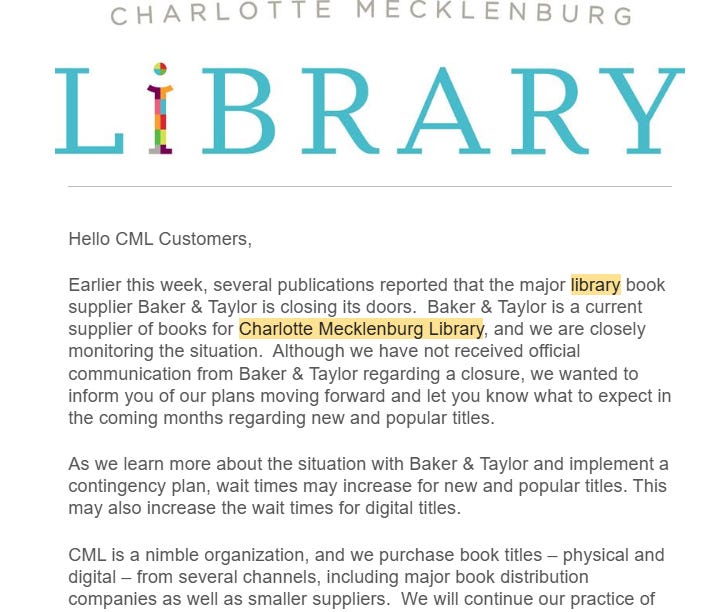
I then proceeded to put on my Colombo trench coat and cigar and dig into who Baker and Taylor are and why they messed up my library.
Who are Baker and Taylor?
“So, after 200 years in business, the Charlotte-based library book distributor Baker & Taylor is shutting down operations by January. (PublishersWeekly.com) The company is cutting over 500 jobs nationwide — including 112 roles in the Charlotte region alone — as a result of a failed acquisition deal and ongoing financial challenges. “
TakeAways:
The closure comes after the planned sale to ReaderLink collapsed, and senior leadership determined there was no viable path forward. (PublishersWeekly.com)
The impact will ripple through the library ecosystem: many libraries report longer wait times for new titles, confusion about orders, and the need to switch vendors. (WCPO 9 Cincinnati)
Upon some more digging:
“Baker & Taylor had made plans to exit the wholesale book distribution business to retailers. The decision was based on aligning with the educational focus of the Follett Corp., the Chicago-based parent company that acquired it in 2016. Follett sells books and supplies to schools, colleges, bookstores, students, and libraries. The purchase of Baker & Taylor was the biggest deal in its history, The Observer reported, although the terms of the deal were not disclosed. Follett sold Baker & Taylor to a private investment group headed by Baker & Taylor CEO Aman Kochar in 2021, according to the company’s website.
So, there it is…Private Equity/Investment is partially behind some of the drama in the book space. I’m not an expert on the PE industry, but many people aren’t feeling it.
Here’s a clip that breaks down why so many people dislike PE: What’s the beef with Private Equity
I hope this closure doesn’t seriously affect mine and other library systems. They are such vibrant and vital spaces for many communities. As a kid, my Mom would take me to the Howard County Library and let me get lost in the books. In my 20s, after losing my job, I would spend hours in the library reading books such as The Four Agreements and The 4-Hour Workweek, which really shaped my thoughts.
Libraries are so needed!! So take your ass to the Library and get lost in the vibe
This situation also highlights the need for a discussion about the future of book distribution and library funding. As we transition to an increasingly digital landscape, how can we adapt our systems to support both traditional print books and digital formats?